




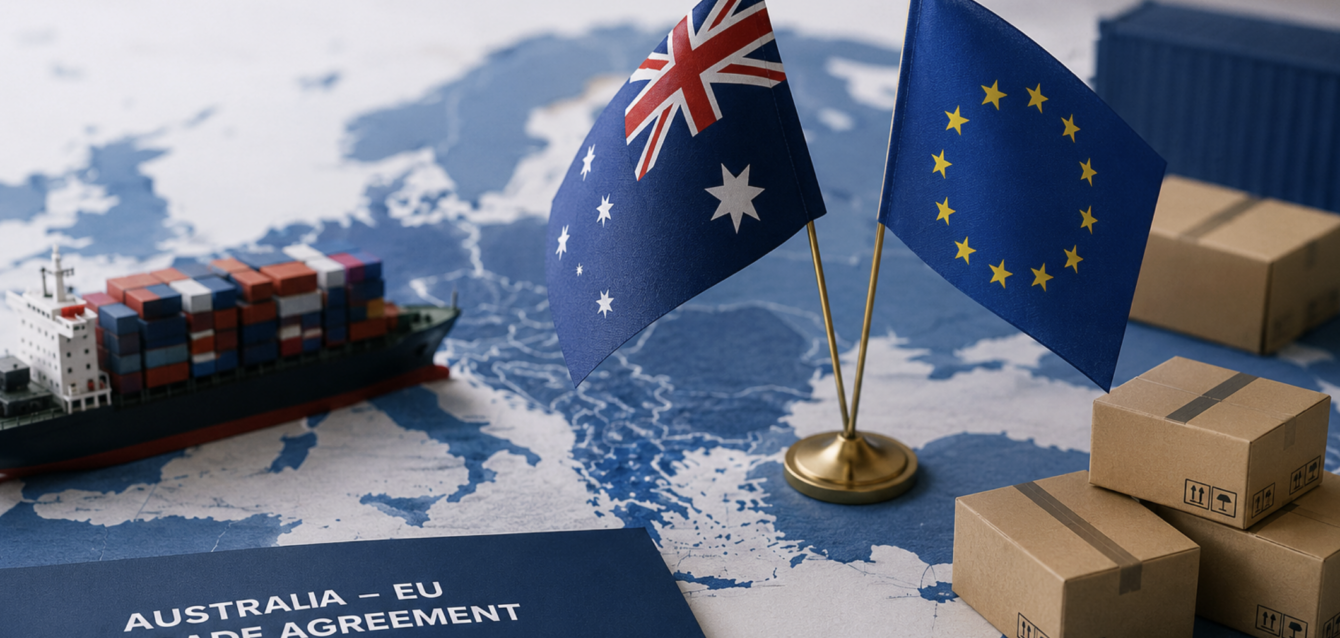
The Australia–EU free trade agreement is not just a win for Australian exporters. It is equally significant for European brands, manufacturers and online sellers who have been eyeing Australia as a growth market. Negotiations concluded on 24 March 2026 and for European businesses, the preparation window starts now.
of EU exports to Australia will be tariff-free once in force (European Commission)
consumers in Australia — English-speaking, digitally native, high disposable income
The EU is Australia’s second largest source of total foreign investment (DFAT)
1. Why Australia Is a Market Worth Taking Seriously
Australia is a stable, English-speaking, high-income market with strong demand for premium imported goods particularly from Europe. Australians have a genuine affinity for European products. Whether it is Italian fashion, German engineering, French cosmetics or Scandinavian homewares, European provenance carries real commercial weight.
Combine that with a sophisticated eCommerce market and you have a compelling opportunity for European brands ready to build a real presence. And unlike the US or Asian markets, there is no language barrier, a familiar legal system, and strong intellectual property protections.
2. What the FTA Changes for European Businesses
The European Commission has confirmed that the agreement will remove over 99% of tariffs on EU exports to Australia once it takes effect. This is a material commercial improvement for European brands where tariff costs have historically made pricing difficult or margins unsustainable in the Australian market.
Importantly, the impact differs by product category. For some goods, current tariffs into Australia are modest. For others certain fashion, food and manufacturing goods, the removal of duties alongside associated freight cost reductions can meaningfully shift the competitive landscape.
In practical terms, European businesses can expect:
- A direct improvement in landed cost, making Australian retail and wholesale pricing more competitive
- Stronger confidence to invest in distributor or retailer partnerships that previously looked marginal on price
- More flexibility to test eCommerce pricing without being undercut by locally made alternatives
- A clearer regulatory and trade framework that reduces uncertainty in commercial planning
- Better conditions for long-term sourcing and supply chain decisions anchored in Australia
“
The brands that build their Australian distribution infrastructure now, before the FTA takes full effect, will be the ones who capture the opportunity fastest when tariffs drop.
FULFILLWORKS
3. The eCommerce Path into Australia: Start Smart, Scale Later
European businesses often assume that entering a new market requires a local office, a local team and significant upfront investment. That is no longer true, especially for eCommerce-capable brands.
The most effective entry strategy for many European businesses is a staged model: start with cross-border eCommerce to test demand, build a customer base, and understand what sells. Once volume and unit economics are proven, move to local inventory held with a Melbourne-based 3PL like FulfillWorks. That unlocks faster delivery, better customer experience and more competitive shipping costs.
- Cross-Border eCommerce Test: Sell from Europe via Shopify or Amazon Australia. Ship direct from your warehouse or a freight forwarder. Validate product-market fit without local inventory commitment.
- Marketplace Expansion: Add Amazon Australia, Catch or MyDeal listings to broaden reach. Cross-border fulfilment still works here; delivery takes 7–14 days but gives you real demand data.
- Local Inventory with FulfillWorks: Ship a container or pallet to our Melbourne warehouse. We receive, store and fulfil orders locally with same-day dispatch, Australian delivery speeds, proper returns handling.
- Full Multi-Channel Growth Connect all channels: DTC website, marketplaces, wholesale accounts — to one fulfilment system. Scale without adding operational complexity.
4. What European Businesses Must Plan for Before Entering Australia
Even with a free trade agreement, market entry requires operational preparation. Australia has specific import requirements, consumer expectations and tax obligations that differ from Europe. Getting this right before launch saves costly mistakes later.
| Consideration | What you need to know | Who handles it |
|---|---|---|
| GST (10%) | Australian imports are generally subject to 10% Goods and Services Tax. You may need to register for GST depending on your sales volume. | Your accountant |
| Import Declarations | Commercial shipments entering Australia require customs documentation. A licensed customs broker simplifies this significantly. | Freight broker |
| Biosecurity & Quarantine | Certain goods particularly food, plant-based materials and animal products, are subject to DAFF biosecurity inspection on arrival. | FulfillWorks can assist |
| Labelling & Compliance | Australian labelling requirements differ from EU/CE standards. Product descriptions, warnings and ingredient lists must meet ACCC requirements. | Legal / regulatory adviser |
| Container Unpacking | If shipping by sea freight, your goods arrive in containers that need to be unpacked, inspected and stored efficiently. | FulfillWorks handles this |
| Local Storage & Fulfilment | Once goods are in Australia, you need a cost-effective model to store inventory and fulfil customer orders quickly. | FulfillWorks handles this |
5. Why Local Fulfilment in Australia Is a Game-Changer
For European brands serious about growing in Australia, cross-border shipping has real limitations: 2–3-week delivery times, higher per-unit shipping costs, complex returns, and a customer experience that does not match what Australian consumers expect in 2026.
Local fulfilment solves all of this. By holding inventory in Melbourne, the logistics hub of Australia you can offer same-day or next-day dispatch, returns handling, and delivery speeds that compete with any domestic brand. That is what allows you to build real customer loyalty, not just one-off purchases.
How FulfillWorks Supports European Brands Entering Australia
Receiving
Container Unpacking
We unpack sea freight containers, inspect goods and integrate stock into our inventory system from day one.
Compliance
Biosecurity Inspection
We assist with DAFF biosecurity clearance requirements for goods subject to Australian quarantine inspection.
Storage
Receiving & Storage
Secure, scalable warehouse space across our two Melbourne locations with real-time inventory visibility.
Fulfilment
Pick & Pack
Orders picked with 99%+ accuracy, packed professionally, with branded packaging options available.
Dispatch
Same-Day Dispatch
Orders placed before cut-off shipped same day via DHL, Aramex, Australia Post, Sendle and more.
Returns
Returns Handling
Australian returns managed locally, inspected, restocked and reported. No need to ship returns to Europe.
Integration
Multi-Channel Integration
Connect Shopify, WooCommerce, Amazon AU, Catch, Cin7, DEAR, Unleashed and more into one system.
Cold chain
Cold Storage
For European food, beverage or pharmaceutical brands requiring temperature-controlled storage in Australia.
Scaling support
Retail & Marketplace Fulfilment
We help European brands fulfil orders to Australian retailers, marketplaces and Amazon shipping locations.
6. The Right Time to Start Is Before the FTA Takes Effect
The agreement still needs to go through legal finalisation and ratification a process that typically takes 12–24 months. But that is precisely why now is the moment to act, not wait.
European businesses that use this window to research the Australian market, establish a fulfilment model, test eCommerce demand and build distributor relationships will be 12–18 months ahead of competitors who wait until the FTA is formally in force.
Your pre-FTA action plan for Australia:
- Research which Australian channels and platforms are best for your product category
- Map your landed cost model including current tariffs, freight, GST and FulfillWorks storage and pick fee
- Audit your packaging and labelling for Australian compliance requirements
- Consider a small initial stock shipment to test demand with real Australian customers
- Talk to FulfillWorks about a fulfilment setup that matches your entry strategy